
DNBSEQ™ Technology
How does DNBSEQ™ technology differ from more traditional methods?
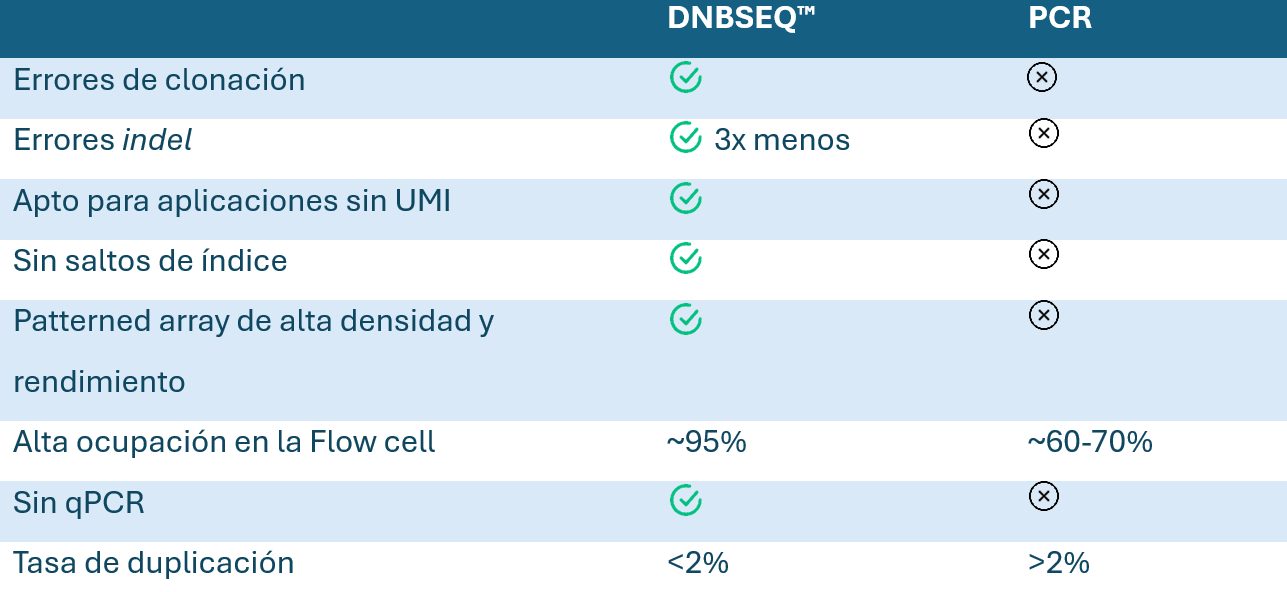
Higher accuracy — Greater efficiency
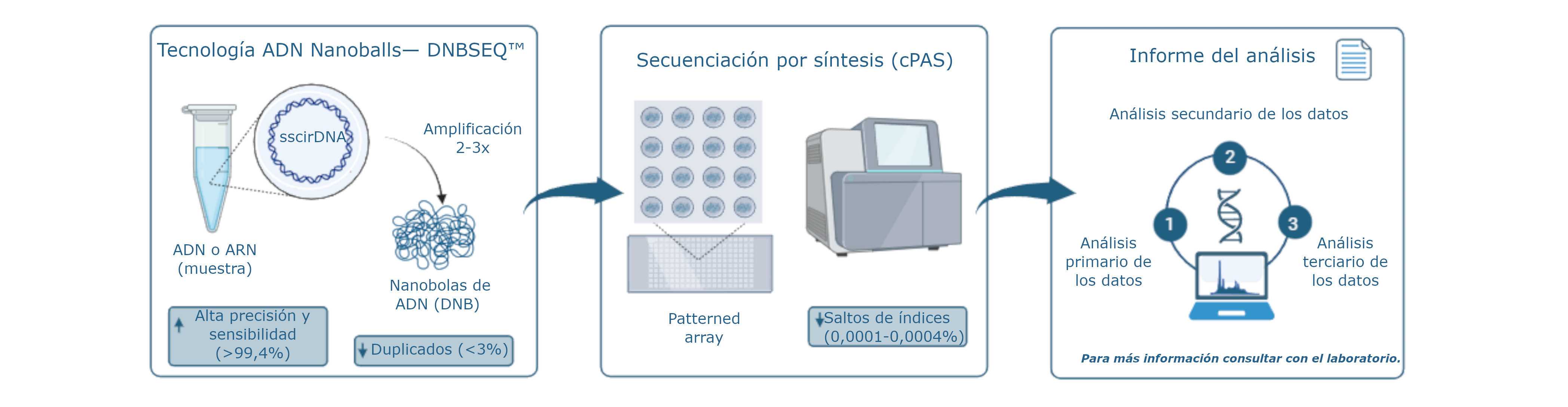
How DNBSEQ™ technology works in NGS sequencing platforms
For more details on sequencing data and results, click here.
This technology called DNBSEQ is based on DNA nanoballs (DNB). Created during library preparation, compact DNBs are loaded into flow cells and the sequence is read with four fluorescent probes recognising the four DNA bases. Lasers then excite the probes while millions of images are taken to identify the bases. These images undergo image analysis followed by bioinformatic analysis to identify the pathogenic and likely pathogenic variants found.
During sequencing library preparation, single-stranded circular DNA molecules (ssCirDNA) are created. Typical double-stranded DNA fragments, with adapter sequences at the terminal ends, are heated to generate ssDNA. An oligonucleotide hybridises to both ends of the ssDNA to form ‘nicked’ circles while a DNA ligase repairs the ‘nick’, creating complete single-stranded circles.
Using the single-stranded circle, rolling-circle replication (RCR) creates billions of DNA nanoballs (DNB) in a single tube. Each copy is made from the original DNA circle, eliminating clonal amplification errors and reducing GC-content bias and dropouts typically caused by PCR.
The DNBs are loaded into ‘flow cells’, which have an array with a pattern of uniformly spaced ~200 nm binding sites at submicrometric distances. Each site binds a single DNB, ensuring high throughput of accurate reads with a sharp signal and no interference from adjacent DNBs.
From there, combinatorial probe-anchor synthesis (cPAS) chemistry hybridises sequencing primers to the DNBs, and fluorescently labelled probes with reversible termination are incorporated by a patented DNA polymerase in consecutive sequencing cycles. The fluorescent probes are then excited with laser light and the DNB array is imaged with cameras.